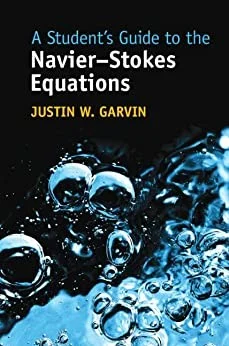
A Student's Guide to the Navier-Stokes Equations
(Autor) Garvin Justin W Justin W. GarvinThe Navier-Stokes equations describe the motion of fluids and are an invaluable addition to the toolbox of every physicist, applied mathematician, and engineer. The equations arise from applying Newton's laws of motion to a moving fluid and are considered, when used in combination with mass and energy conservation rules, to be the fundamental governing equations of fluid motion. They are relevant across many disciplines, from astrophysics and oceanic sciences to aerospace engineering and materials science. This Student's Guide provides a clear and focused presentation of the derivation, significance and applications of the Navier-Stokes equations, along with the associated continuity and energy equations. Designed as a useful supplementary resource for undergraduate and graduate students, each chapter concludes with a selection of exercises intended to reinforce and extend important concepts. Video podcasts demonstrating the solutions in full are provided online, along with written solutions and other additional resources.
Garvin Justin W
Justin W. Garvin
Other related


The Illustrated Encyclopedia of Science
Explore the Wonders of Life, Matter, Energy, and More