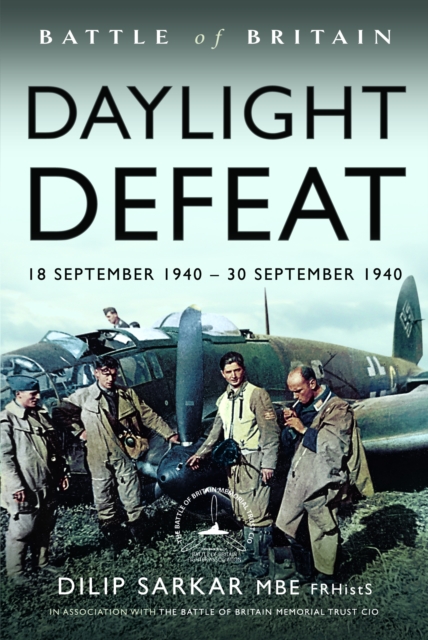
Battle of Britain Daylight Defeat
18 September 1940 - 30 September 1940
(Author) Dilip Sarkar MBEIn this, the sixth of Dilip Sarkar's unprecedented eight-volume series, the day-by-day events occurring in the fourth phase of the Battle of Britain are chronicled and set within a much wide context, including the operations of Bomber and Coastal Commands and the Home Front. Renowned for his evidence-based approach, the author has returned to primary sources, the analysis arising often challenging our previous understanding and the popular narrative. In Volume 5, Target London: 7 September 1940 - 17 September 1940, the beginning of the Blitz was explored at length. This illuminated the inescapable fact that Luftwaffe air intelligence completely failed to understand how Fighter Command was organised and controlled, nor that it was replacement pilots, not aircraft, that was Air Chief Marshal Dowding's greatest concern. Indeed, on 15 September 1940, Luftwaffe aircrews were briefed to expect but a token resistance over London from the last handful of RAF fighters - their morale shattered when their first attack was met by over 300, the second by nearly as many. This convinced Hitler that the Luftwaffe could not achieve the aerial superiority needed for the invasion of Britain to proceed. Two days later Operation Seelöwe was postponed 'indefinitely'. Reichsmarschall Herman Göring, however, still believed that the Luftwaffe could prevail - and so continued attacking the UK, changing tack, yet again. As London had proved it 'could take it', the Luftwaffe, whilst continuing to bomb the capital by night, now focussed its daylight attacks on the British aircraft industry. Naturally the Supermarine Spitfire factory at Southampton was a primary target; it was subsequently badly hit, with great loss of life. Other factories, in the West Country, were also targeted, and, owing to a navigation error due to cloud cover, the picturesque town of Sherborne was devasted on 30 September 1940. By that date, however, it was clear that Göring's He 111 force was unable to continue absorbing such losses and the type was exclusively switched to night-bombing - thereby substantially reducing the German daylight bombing force. On 20 September 1940, Me 109 fighter-bombers attacked London, and going forward the next and final phase would see such attacks, and high-flying fighter sweeps, dominate the daytime arena. Such raids, though, were never going to defeat Britain, so it is fair to say that the period reviewed in this volume really did see the 'Daylight defeat' of the Luftwaffe over England in 1940 - and the events involved are interpreted and recounted in great detail.
Dilip Sarkar MBE
Dilip Sarkar MBE is a British author and historian known for his work on military history, particularly focusing on the air war during World War II. He has written numerous books on the subject, with a particular emphasis on the experiences of RAF aircrew. Sarkar's writing style is characterized by meticulous research and detailed storytelling, providing a compelling and insightful look into the lives of those who fought in the war. His most famous work is "The Few: The American "Knights of the Air" Who Risked Everything to Fight in the Battle of Britain," which explores the contributions of American pilots in the iconic battle. Sarkar's contributions to literature have had a significant impact on the genre of military history, shedding light on lesser-known aspects of World War II and honoring the bravery and sacrifices of those who served.
Other related
Battle of Britain Airfields Under Attack
19 August 1940 – 6 September 1940

Battle of Britain Target London
7 September 1940 – 17 September 1940

'Sailor' Malan - Freedom Fighter
The Inspirational Story of a Spitfire Ace
Spitfire Ace of Aces
The Album : The Photographs of Johnnie Johnson

Johnnie Johnson's 1942 Diary
The War Diary of the Spitfire Ace of Aces



365 Lessons from the Stoics
Transform Your Daily Life Using the Stoics’ Wisdom and Understanding
