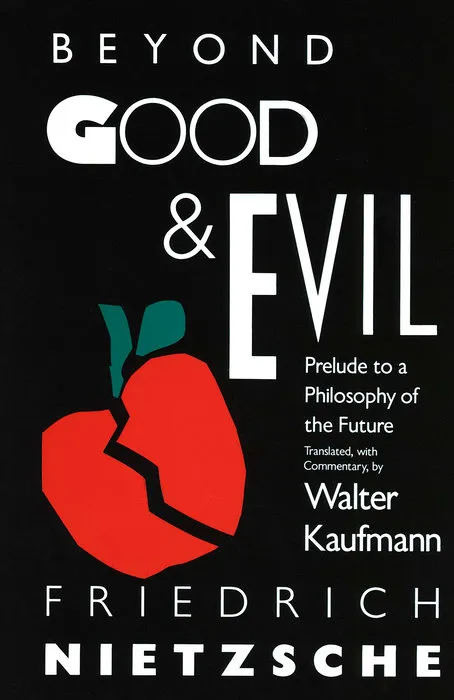
Beyond Good & Evil
Prelude to a Philosophy of the Future
(Author) Friedrich NietzscheOne of the most remarkable and influential books of the nineteenth century—Nietzsche's attempt to sum up his philosophy. In nine parts the book is designed to give the reader a comprehensive idea of Nietzsche's thought and style: they span "The Prejudices of Philsophers," "The Free Spirit," religion, morals, scholarship, "Our Virtues," "Peoples and Fatherlands," and "What Is Noble," as well as epigrams and a concluding poem. This translation by Walter Kaufmann has become the standard one, for accuracy and fidelity to the eccentricities and grace of the style of the original. The translation is based on the only edition Nietzsche himself published, and all variant reading in later editions. This volume offers an inclusive index of subjects and persons, as well as a running footnote commentary on the text.
Friedrich Nietzsche
Friedrich Nietzsche was a German philosopher, cultural critic, poet, and philologist, known for his profound influence on Western philosophy and literature. His most notable works include "Thus Spoke Zarathustra," "Beyond Good and Evil," and "The Birth of Tragedy." Nietzsche's writing style was characterized by his use of aphorisms, paradoxes, and poetic language, which challenged traditional philosophical conventions.
Nietzsche's contributions to literature include his exploration of existential themes, the concept of the "Ubermensch" (overman), and the reevaluation of moral values. His ideas on the will to power, eternal recurrence, and the death of God have had a lasting impact on literature, philosophy, and cultural criticism.
Nietzsche's most famous work, "Thus Spoke Zarathustra," is a philosophical novel that explores themes of individualism, self-overcoming, and the pursuit of meaning in a godless world. The book has been praised for its literary style and innovative approach to philosophical storytelling, cementing Nietzsche's legacy as one of the most influential thinkers of the modern era.
Other related

The Will to Power an Attempted Transvaluation of All Values